
Choosing a Forklift Battery can affect uptime, operating costs, and the pace of a warehouse shift. Yet the right choice is rarely obvious from a product label. A battery that performs well in a busy distribution center may not suit a small facility with one daily shift. Details matter. Charging access, lift capacity, operating hours, and temperature all shape the decision.
This guide compares 10 forklift battery options for businesses in 2026, including lead-acid and lithium-ion models. It considers practical factors such as voltage, capacity, charging time, maintenance needs, expected service life, and warranty coverage. Specifications vary by configuration, so confirm them with the manufacturer or an authorized dealer before ordering. A few minutes spent checking equipment requirements can prevent a costly mismatch.
Price is only part of the picture. A lower upfront cost may come with more frequent watering, longer charging periods, or scheduled battery changes. On the other hand, advanced features may offer little value if your trucks run only occasionally. That is the part buyers sometimes overlook. No list can name one universal winner; the best fit depends on your workload, facility, and budget. Use these comparisons as a starting point, then verify compatibility with your forklift and charging setup.
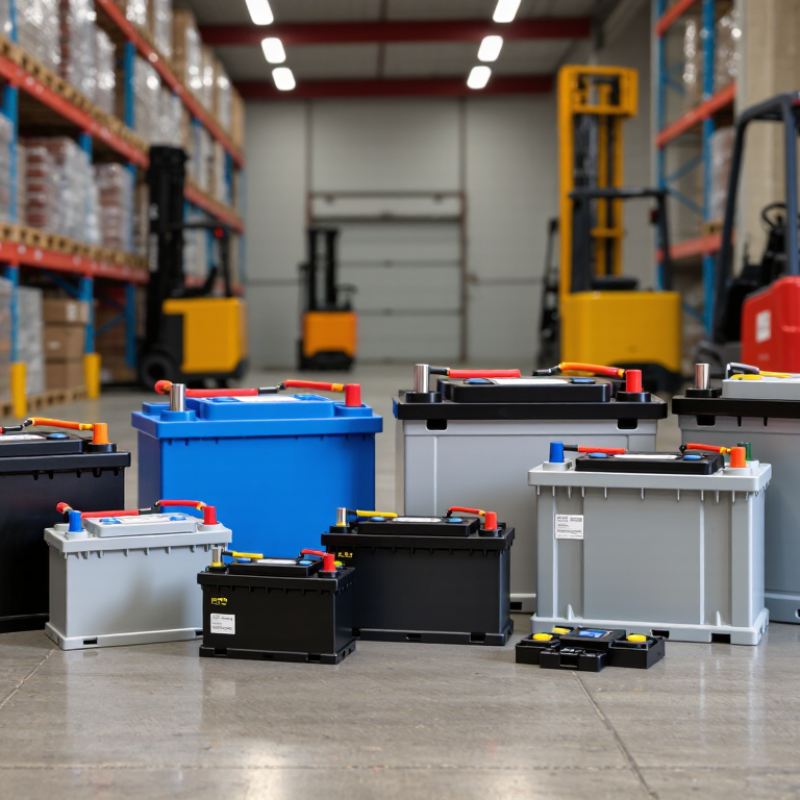
Forklift battery selection starts with the truck’s required voltage, not a guess based on charger availability. Check the equipment nameplate and manual; mismatched voltage can reduce performance or damage equipment. Amp-hour capacity describes charge delivery over a specified period. Actual usable capacity varies with temperature, battery age, discharge rate, and maintenance. Cold aisles matter. So does a long lift cycle.
Match capacity to shift demand. Track operating hours, travel distance, load weight, lift height, and breaks across several representative days. One busy shift may not reflect normal use. For multi-shift operations, check whether charging windows and approved opportunity charging can meet demand without exceeding battery limits. A battery that looks adequate on paper may struggle during repeated heavy lifts. Estimates are imperfect; validate them with run-time records and qualified service guidance.
Tips: Record state of charge at shift start and end for one week. Note charging time, temperature, and slowdowns. Compare these observations with the battery and charger specifications. Keep a practical reserve instead of planning around ideal conditions. Confirm fit, connector type, and charger compatibility before ordering. Small checks help prevent expensive surprises.
Illustrative battery configurations and their nominal energy capacity. Nominal energy is calculated as voltage × amp-hour capacity ÷ 1,000.
The examples range from 14.4 kWh (24 V, 600 Ah) to 56 kWh (80 V, 700 Ah). Actual shift runtime depends on lift height, load, travel distance, operating conditions, battery chemistry, and the usable portion of battery capacity. Match battery specifications to the truck and your shift requirements.
A forklift battery’s efficiency affects more than the electricity bill. It also shapes charging time, heat, and how much energy reaches the wheels and lift system. Lead-acid batteries are often rated near 80% efficiency, while lithium-ion systems may approach 95%. These are typical figures, not guarantees; test methods and operating conditions can change the result.
Consider a truck returning from a busy shift with a warm battery and little time before the next one. At 80% efficiency, more incoming energy is lost during charging and use; at 95%, less is lost. For the same useful energy, that difference can reduce electricity demand, though actual savings depend on workload, charger performance, and battery age. A cool warehouse, frequent short trips, or long waits between shifts can all change the comparison. Small details matter.
One caution: efficiency percentages alone do not predict total operating cost. Lead-acid batteries may need watering and scheduled maintenance, while lithium-ion batteries have different purchase and service costs. I would compare measured energy use across a representative week, including charging losses and downtime. It is easy to overlook the charger. A meter at the charging point can reveal whether the expected efficiency advantage appears in your own operation.
A useful 10-option comparison should show cycle life, charging time, and warranty terms side by side. Typical published specifications put flooded lead-acid batteries at roughly 1,000–1,500 cycles, while lithium iron phosphate options often list 2,000–4,000. Treat these as indicative ranges, not promises: heat, deep discharges, and missed watering can shorten service life. Lead-acid packs may need an eight-hour charge and cooling period; lithium packs can often recharge in one to two hours. Check whether the quoted cycle count assumes a particular discharge depth.
Warranty wording matters. Compare years covered, cycle or energy-throughput limits, and the capacity remaining when coverage ends. A long warranty can still leave gaps. BloombergNEF reported an average lithium-ion battery-pack price of $115 per kilowatt-hour in 2024, down 20% from 2023; this is market context, not a forklift-battery quote. For each candidate, calculate cost per expected working cycle using the actual purchase price, charging routine, and shift pattern. A warehouse running two shifts may value opportunity charging differently from a single-shift site. The spreadsheet can look precise, but real duty cycles are messy. Check the fine print before ranking the ten options.
| Battery Option | Typical Cycle Life* | Typical Charge Time | Common Warranty Range** | Best Suited For | Key Trade-Off |
|---|---|---|---|---|---|
| Flooded lead-acid | About 1,000–1,500 cycles | About 8–10 hours, followed by a cooling period | About 1–3 years | Single-shift operations with scheduled charging and battery changes | Requires watering, ventilation, cleaning, and dedicated charging space |
| Tubular-plate lead-acid | About 1,200–1,800 cycles | About 8–10 hours, plus cooling time | About 1–3 years | Regular industrial use where a robust lead-acid design is preferred | Still needs routine maintenance and long charge windows |
| AGM lead-acid | About 500–1,000 cycles | About 6–10 hours; follow the battery maker’s charge profile | About 1–2 years | Low-maintenance applications with moderate duty cycles | Often less cycle life than traction-focused flooded or lithium options |
| Gel lead-acid | About 600–1,000 cycles | About 8–12 hours; charging must be carefully regulated | About 1–2 years | Operations seeking a sealed, low-maintenance lead-acid battery | Sensitive to incorrect charging and generally not suited to frequent fast charging |
| Thin-plate pure lead (TPPL) | About 1,000–1,500 cycles | Often about 2–4 hours with a compatible charger | About 2–5 years | Multi-shift work that can use planned opportunity charging | Higher purchase cost than conventional flooded lead-acid; charger compatibility matters |
| NMC lithium-ion | About 1,500–3,000 cycles | About 1–2 hours with a compatible high-rate charger | About 3–5 years | Space-constrained fleets needing a compact battery with fast charging | Thermal management and battery-management safeguards are important |
| Lithium iron phosphate (LFP) | About 2,000–4,000 cycles | About 1–3 hours, depending on capacity and charger output | About 5–10 years | Multi-shift fleets seeking opportunity charging and reduced routine maintenance | Higher upfront cost; battery and charger must be designed to work together |
| High-power LFP | About 2,000–4,000 cycles | Often about 1–2 hours; frequent short top-ups may be possible if approved | About 5–10 years | High-throughput operations with short breaks and limited battery-swap space | Requires adequate electrical capacity and a compatible charging system |
| Lithium titanate (LTO) | About 10,000–20,000 cycles in suitable designs | Potentially about 15–60 minutes with a system designed for fast charging | About 5–10 years; varies by system and usage | Intensive duty cycles where very rapid charging and long service life are priorities | High initial cost and more limited availability than common battery chemistries |
| Refurbished flooded lead-acid | Remaining life varies; roughly 500–1,000 cycles may be possible after refurbishment | About 8–10 hours, plus cooling time | Commonly about 6–12 months | Budget-sensitive fleets with predictable, lighter duty | Condition and remaining capacity can vary; request a load test and written warranty terms |
* Cycle-life figures are approximate industry ranges, not guaranteed service life. They depend on battery design, depth of discharge, temperature, charging practices, and the manufacturer’s end-of-life definition. **Warranty periods are common market ranges, not standardized terms; confirm coverage, operating-hour limits, and exclusions with the supplier. Charge times assume a compatible charger and may vary by battery capacity, charger output, and operating conditions.
A forklift battery must match the truck’s voltage, compartment dimensions, and required capacity. Start with the data plate and operator manual, not a guess based on the old battery. Record the voltage and amp-hour rating, then measure the compartment’s length, width, and height. Check cable position and connector type, too. A pack that is only slightly too large may not seat safely. One that is too small can shift during operation.
Weight matters as much as fit. The battery may contribute to the truck’s counterbalance, so a lighter replacement can affect stability and load handling. Confirm the permitted battery weight range in the truck documentation. For capacity, consider the length of shifts, travel distance, and lifting frequency. A busy warehouse with repeated lifts may need more usable capacity than a truck used intermittently. Still, buying the largest battery is not automatically better; charging and maintenance routines must suit it.
Tips: Compare the battery specification sheet with the truck’s manual before ordering. Ask a qualified service technician to verify uncertain measurements, especially cable clearance and minimum weight. Measure twice. Compartment dimensions can be awkward, and a rushed check is easy to regret.
A battery’s purchase price is only the opening line in its cost. Compare options by estimating total ownership cost per productive operating hour. Include the battery and charger, electricity, scheduled maintenance, and replacement labor. Divide that total by the hours the battery is expected to power the truck before replacement.
For example, assume a battery and charger cost $10,000 together. If charging electricity averages $450 annually and maintenance costs $600, five years of service totals $15,250. At 1,200 operating hours per year, that is about $2.54 per hour. Treat this as a planning estimate, not a guaranteed result. That matters.
Charging losses, utility rates, shift patterns, and room temperature can change the real figure. A truck that runs two shifts may need opportunity charging or a spare battery; include charger capacity and any battery-swap labor. Maintenance estimates should reflect actual tasks, such as watering and terminal inspections where applicable, plus technician time. Record energy use and service hours for each truck. Revisit the calculation after several months, because a spreadsheet can miss messy realities: idle charging, rushed inspections, or unexpected downtime.
