7 Range Exhaust Buying Tips for Global Buyers
For global buyers, Range Exhaust selection is not a cosmetic decision. It affects smoke removal, kitchen comfort, noise, and installation costs. Lawrence Berkeley National Laboratory’s 2012 field study examined cooking exhaust devices in 15 California homes and found that capture performance varied widely. That finding matters: a large airflow number on a product sheet does not, by itself, prove that smoke and cooking particles will be captured effectively.
Indoor-air researcher Brett Singer, a co-author of the LBNL study, offers a useful buying principle through his research: judge a hood by how well it captures pollutants at the cooking surface, not by airflow claims alone. This is a paraphrase of the study’s practical lesson, not a direct quotation. Buyers should compare capture design, duct compatibility, controls, and measured noise. Ask suppliers for test methods and installation requirements, too. A stainless-steel finish can look convincing under showroom lights, but poor duct planning may undermine performance in a real kitchen.
The seven buying tips ahead focus on those details. Check burner coverage. Confirm duct size and outlet position. Compare airflow and sound ratings using consistent test conditions. Review filters, cleaning access, warranty terms, and local service support. Global projects also face different cabinet dimensions, voltage systems, and delivery constraints. Small details matter.
A lower price may still cost more after installation. And some specifications are confusing. Treat that as a reason to ask better questions, not to assume every supplier is unreliable. This guide helps buyers compare Range Exhaust options with clearer evidence and fewer costly surprises.
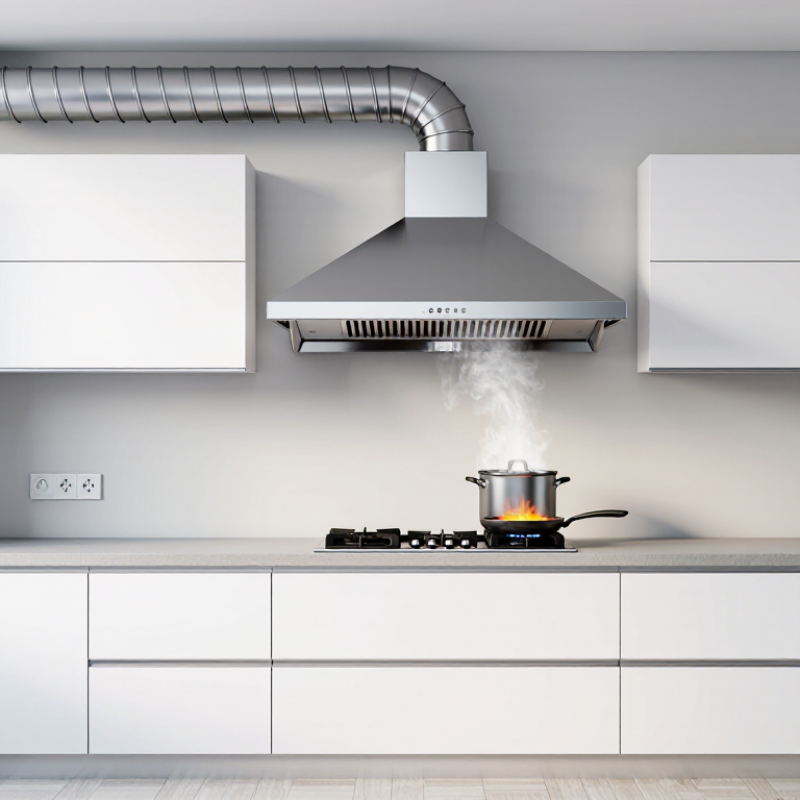
Understanding Range Exhaust Types and Their Intended Uses
Range exhaust systems are not interchangeable; each design suits a different kitchen layout and cooking pattern. Ducted hoods carry smoke, heat, and odors through a duct to an outdoor outlet. They are useful for frequent frying or high-heat cooking when a clear vent route is available. Check duct diameter, route length, and bends before ordering. Restrictive runs can reduce airflow and increase noise. Small details matter.
Recirculating models draw air through grease and charcoal filters, then return it to the room. They fit apartments or kitchens where exterior ducting is impractical. However, they do not remove cooking moisture or heat from the room, and odor control depends on clean filters. Filter replacement costs and availability deserve attention. A low purchase price can hide ongoing upkeep.
Convertible models support either ducted or recirculating operation, depending on installation and included parts. That flexibility may help buyers facing uncertain layouts, but it does not guarantee equal performance in both modes. Match the type to the actual cooking habits, not just the appearance of the hood. Before purchase, confirm clearances, power requirements, and installation details with a qualified local installer. Even careful planning can miss a wall obstruction or awkward cabinet depth.
Matching Hood Size and Airflow to Your Kitchen
A range hood should match the cooking surface before its airflow rating becomes the deciding number. Home Ventilating Institute guidance suggests about 100 CFM per linear foot for wall-mounted hoods and 150 CFM per foot for island hoods. For a 30-inch range, that points to roughly 250 CFM on a wall and 375 CFM over an island. These are starting points, not guarantees. A wide island hood can still miss rising steam if it is mounted too high.
ASHRAE Standard 62.2-2022 sets a kitchen-exhaust baseline of 100 CFM for intermittent operation, or five air changes per hour for continuous operation. That minimum is not a promise of effective smoke capture. A 2012 Lawrence Berkeley National Laboratory field study, “Performance of Installed Cooking Exhaust Devices,” found substantial differences in capture performance among installed devices. Hood depth, placement, duct bends, and make-up air all matter. Fit matters too. Measure the cooktop, then check the manufacturer’s clearance range and the duct route before choosing a higher-CFM model. I would not treat a single sizing formula as precise; real kitchens rarely behave like clean test setups. A small pan near the front burner can reveal a weak capture area faster than a spec sheet.
Comparing Noise Levels, Filters, and Energy Efficiency
Noise ratings deserve more than a quick glance. Compare models at the same airflow setting, since a hood often gets louder as its fan works harder. Check whether the rating is listed in sones or decibels, and compare like with like. A low number at the quietest setting may not tell you how the unit sounds during heavy cooking. Listen in person if possible. Fan pitch matters, too; a steady hum can feel less intrusive than a sharp whine.
Filters affect both performance and upkeep. Washable metal filters can usually be cleaned and reused, but grease still collects in corners and along the frame. Charcoal filters help reduce cooking odors in ductless setups, though they need regular replacement. Check the filter dimensions and removal method before buying. A filter that is awkward to reach may stay dirty longer than intended.
Energy use depends on the motor, controls, and how long the hood runs. Compare power consumption alongside airflow, not in isolation. A highly efficient unit may still disappoint if it cannot clear steam from your usual cooking area. Match capacity to the cooktop and installation, and verify duct size and route with a qualified installer. Long or sharply bent ducts can reduce airflow and increase noise. I would not choose by one specification alone; it is easy to miss a practical detail.
Verifying Materials, Safety Standards, and Supplier Support
When evaluating a range exhaust system, begin with the materials, not the brochure. Ask for the stainless-steel grade and sheet thickness, plus documentation for coatings and fasteners. A polished surface can hide thin metal. Request a sample or close-up photos, then inspect edges, welds, and joints for roughness or gaps. Small details matter.
Safety claims need evidence. Verify that the model has been tested to standards relevant to its destination and installation. Ask for test reports, electrical ratings, and required clearances in writing. Check airflow capacity against the cooking line, duct layout, and expected heat load; a large number alone proves little. Keep the paperwork.
Supplier support is part of the purchase. Confirm spare-part availability, warranty coverage, response times, and who answers technical questions across time zones. Request manuals, wiring diagrams, and packing details, especially for long-distance shipping. Buyers may focus on price, then wait weeks for a simple replacement part. That is not always the supplier’s fault, but unclear support makes it worse. Reports may not match the exact configuration, so compare model numbers and options carefully.
Planning for Shipping, Installation, and Maintenance Worldwide
Tip 1: Check the route before choosing an exhaust hood. Record the appliance width, duct diameter, outlet position, voltage, and frequency. UNCTAD’s Review of Maritime Transport 2024 reports that over 80% of world trade by volume moves by sea. Crating, port handling, and delivery time therefore matter. A hood may fit the kitchen but still arrive with damaged corners or missing fittings.
Tip 2: Plan installation around the actual kitchen, not a catalog drawing. Confirm ceiling height, duct turns, wall material, and access for future cleaning. Share these details with the supplier and a qualified local installer before shipment. Ask for clear wiring diagrams and installation instructions in advance. Recheck measurements yourself; small errors can become expensive after the crate arrives.
Tip 3: Treat maintenance access as a buying requirement. Make sure grease filters can be removed without tools or awkward reaching, and confirm replacement availability. Ask how often filters and ducts need inspection under your expected cooking load. Heavy use changes the schedule. One overlooked detail: a quiet, efficient system is still inconvenient if nobody can clean it safely.
Range Exhaust Buying Tip: Check Local Voltage Before Ordering
Typical nominal single-phase household supply is 120 V in the United States and Canada, 230 V in the United Kingdom, Australia, and India, and 100 V in Japan. Actual electrical services and local requirements can vary. Before shipping, confirm that the range hood’s voltage and frequency match the installation site, and arrange qualified installation and routine filter and duct maintenance.