How to Choose an Air Cooled Water Chiller
Choosing an air cooled water chiller is not just a matter of matching a cooling-capacity number to your equipment. The right choice depends on the heat your process actually produces, the required water temperature, and the conditions around the unit. A chiller rated at a particular capacity may deliver less cooling on a hot afternoon. That detail matters.
Start with the operating requirements. Estimate the heat load, then confirm the required leaving-water temperature and flow rate with a qualified supplier or engineer. Check the manufacturer’s performance data at your expected outdoor temperature, not only under standard test conditions. Small details matter. A unit placed beside a hot exhaust outlet or in a poorly ventilated enclosure may struggle to reject heat, even when its rated capacity looks suitable on paper.
This guide explains how to compare capacity, energy use, installation needs, controls, maintenance access, and supplier support. It also covers practical questions, such as whether the site has enough clearance for airflow and how seasonal temperature changes affect performance. Look beyond the purchase price: fan and compressor efficiency, cleaning needs, and service availability influence long-term operating costs. No selection method is perfect. Early load estimates can be uncertain, so verify assumptions against real process data whenever possible. A careful comparison helps you choose a chiller that fits the job, rather than one that simply looks right on a specification sheet.
Define the Design Cooling Load in kW or Tons of Refrigeration
How to Choose an Air Cooled Water Chiller
Start by defining the design cooling load, not by choosing a chiller from a rough floor-area estimate. List every heat source that must be removed: process equipment, pumps, people, lighting, and heat entering through walls or ventilation. Use peak operating conditions, including the hottest expected production period. Small loads add up.
For water-based systems, estimate the process load with Q (kW) = 4.186 × flow (L/s) × temperature difference (°C). For example, 2 L/s cooled by 5°C requires about 41.9 kW of cooling. Confirm the actual flow and entering and leaving water temperatures; guessed values can distort the result. One refrigeration ton equals approximately 3.517 kW.
The calculated load is not automatically the chiller’s required nameplate capacity. Check the manufacturer’s available capacity at your design air temperature and water temperatures, since hot outdoor air can reduce output. Include known future loads and a reasonable allowance for uncertainty, but avoid adding a large safety margin without evidence. Oversizing can cause frequent cycling, especially when demand falls. Revisit the estimate after checking equipment data and operating schedules. That step is easy to skip.
How to Choose an Air Cooled Water Chiller - Define the Design Cooling Load in kW or Tons of Refrigeration
| Illustrative Application |
Estimated Design Cooling Load (kW) |
Equivalent Load (TR) |
Preliminary Capacity Target with 10% Allowance (kW) |
Example Nominal Chiller Capacity to Evaluate (kW) |
| Small production process |
18 |
5.12 |
19.8 |
20 |
| Injection molding process |
52 |
14.78 |
57.2 |
60 |
| Commercial cooling application |
85 |
24.17 |
93.5 |
100 |
| Food processing application |
120 |
34.12 |
132 |
140 |
| Data center cooling application |
250 |
71.08 |
275 |
280 |
| Conversion: 1 ton of refrigeration (TR) = 3.517 kW. Select capacity using the chiller’s rated output at the actual design conditions, not nominal capacity alone. |
The application loads and 10% allowance shown are illustrative preliminary estimates, not measured or universal design values. Determine the actual peak cooling load from the process or building heat balance. Before selecting a unit, verify its available capacity at the required leaving-water temperature, water flow rate, and design outdoor ambient temperature; high ambient temperatures can reduce air-cooled chiller capacity.
Select Chilled-Water Temperatures; 7°C Supply and 12°C Return Are Common
When choosing an air-cooled water chiller, start by confirming the chilled-water temperatures your building actually needs. A 7°C supply and 12°C return are common design conditions for comfort cooling. That creates a 5°C temperature difference across the load. It is a useful reference, not a universal rule. Fan-coil units, air handlers, and process equipment may perform differently at other temperatures.
A larger temperature difference can reduce the water flow needed for the same cooling duty, but only if the coils can transfer heat effectively. Check the equipment schedule, room loads, and manufacturer performance data before setting the chiller selection point. On site, compare supply and return readings after the system has stabilized; a blocked strainer or poorly balanced circuit can make the measured difference misleading. Small details matter.
I would not treat 7°C and 12°C as fixed targets. Higher supply temperatures may suit some applications, while low-temperature processes can require much colder water and insulation against condensation. There is a trade-off. Changing temperatures can affect chiller capacity, pump energy, and coil output, so confirm the whole system together. The familiar numbers are a good starting point, but sometimes designers lean on them too heavily.
Check Rated Capacity at 35°C Outdoor Air (95°F)
How to Choose an Air Cooled Water Chiller
Check Rated Capacity at 35°C Outdoor Air (95°F)
A chiller’s capacity depends on the air entering its condenser. AHRI Standard 550/590 uses 95°F (35°C) outdoor air as a common rating condition for air-cooled equipment. Treat that figure as a comparison point, not a promise of equal output in every climate. Ask for certified capacity and power data at your actual entering-air temperature, leaving-water temperature, and flow rate. Small changes matter.
Check the local design weather, too. ASHRAE Handbook—Fundamentals lists outdoor design conditions at 0.4%, 1%, and 2% annual frequencies; these represent different levels of expected temperature exceedance. Compare the chiller’s performance table with the design dry-bulb temperature selected for your site, rather than relying on a city’s average summer high. At 40°C, for example, a unit may deliver less capacity than its 35°C rating. The exact reduction depends on the equipment and operating conditions, so don’t guess a percentage. Request the manufacturer’s selection data at the project conditions, then check that the remaining capacity covers the actual cooling load. One oversight is easy: checking capacity while overlooking the electrical input at peak ambient. Recheck both.
Compare Efficiency by Full-Load kW/ton and AHRI 550/590 IPLV
An air-cooled water chiller’s full-load kW/ton shows how much power it uses near peak demand; lower is generally better under identical rating conditions. But buildings rarely stay at peak load.
AHRI Standard 550/590 evaluates part-load performance using
100%
75%
50%
and
25%
load points, weighted
1%, 42%, 45%, and 12%
in the IPLV calculation. That weighting makes the 50% and 75% results especially influential. Compare certified ratings using the same standard and metric, not sales figures with different assumptions.
Tips: Ask for the AHRI rating sheet. Check full-load kW/ton and IPLV side by side. Also confirm the stated entering-air temperatures and chilled-water conditions match your project. Small differences matter.
A strong IPLV can indicate efficient part-load operation, but it cannot predict every site’s bill. Climate, setpoints, airflow, maintenance, and cycling affect real performance. I would treat the rating as a useful comparison, not a promise.
This comparison is imperfect: a chiller serving steady process loads may spend far more time near full capacity than AHRI’s weighting suggests. Match the rating to measured load patterns when available.
Verify Site Clearances, Airflow, Electrical Supply, and Sound Limits
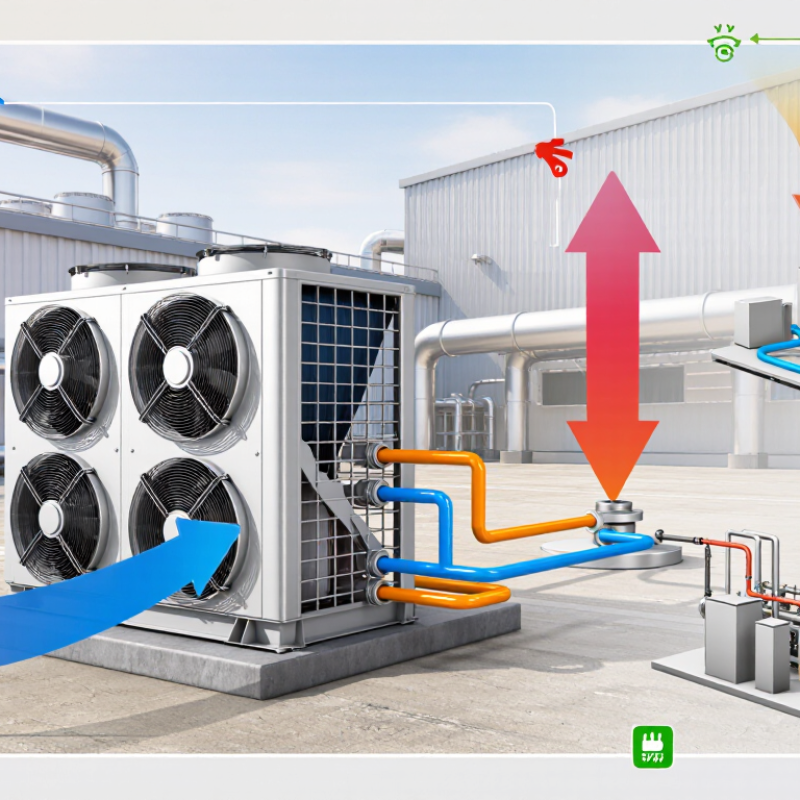
When choosing an air-cooled water chiller, check the installation drawing against the actual site—not just the equipment footprint. Measure wall gaps, service access, overhead obstructions, and nearby fences. Follow the manufacturer’s stated clearances; there is no safe universal distance. Poor spacing can restrict condenser airflow or send hot discharge air back through the coils. On a still, warm afternoon, that recirculation may become obvious as rising head pressure and reduced capacity. Leave room for maintenance, too. A clearance that works on paper may fail when a technician opens a panel.
Confirm the electrical supply with the chiller’s nameplate and a qualified electrical professional. Verify voltage, phase, available capacity, overcurrent protection, and cable routing before delivery.
For sound, review the published sound-pressure data and check the proposed measurement distance and operating conditions. ASHRAE’s HVAC Applications Handbook treats sound control as a site-planning concern; a rating alone cannot predict reflections from a hard courtyard wall. NIOSH’s Criteria for a Recommended Standard: Occupational Noise Exposure recommends limiting workplace exposure to 85 dBA over eight hours, using a 3-dB exchange rate. That is an occupational exposure guideline, not a property-line limit. Still, it is a useful reminder: sound adds up. Check local project requirements, and consider nighttime operation. A neat plan can still miss a neighbor’s bedroom window.